
Overview
Figure 4-1: Source: https://pixabay.com/en/earth-internet-globalisation-2254769/ Permission: CC0 1.0 Public Domain. Courtesy of TheDigitalArtist.
In the first three modules, we have principally engaged in a conceptual discussion. We have introduced and critically examined the concept of global citizenship. We have noted that the ideal of global citizenship has been increasingly invoked by those who seek to address issues of global inequality, poverty, and hardship. Yet, there is little to connect ‘global’ citizenship to ‘national’ citizenship. Who is to define and enforce the reciprocal set of rights and obligations that define citizenship on the global level? We next examined the positions of cosmopolitanism and communitarianism as essentialized positions on the processes of global citizenship. Communitarians are highly skeptical of the possibility of meaningful citizenship above the state and argue that even if possible, it would be undesirable. Cosmopolitans, on the other hand, argue that not only is globalization and some form of global citizenship possible, but it may also be necessary to deal with the transnational issues that we face – from climate change to transnational terrorism. However, these two positions might lead one to assume that this is an either-or proposition. That globalization is good or bad. That global citizenship is real or not. However, by looking at the English School, we were able to take a more nuanced view of these debates. If we conceptualize the concepts of globalization and global citizenship more as a spectrum, ranging from a state-based system with little or no shared norms and values to a world society constituted by individuals with deeply shared norms and values, it is possible to understand how the concept of global citizenship may wax and wane. It is possible to see how the concept may thicken as shared norms and values thicken or how the concept may thin as shared norms and values thin. At the heart of all of these debates is the concept of globalization itself – the contemporary economic, political, and cultural transformations that are challenging the sovereign state system that has existed for over 300 years. It is to this debate that we turn to in this module. It will begin by defining the concept of globalization itself. What are the contemporary economic, political, and cultural processes that are challenging the existing global order? What are the actual and possible benefits of these processes? What are the actual and possible costs of these processes? And finally, how does the contestation about globalization frame our discussion of global citizenship? This module will finish the conceptual portion of the course and in the next module, we will be shifting to a practical aspect examining the idea of global citizenship: beyond the state – regional governance.
Learning Material
Figure 4-2: Source: https://pixabay.com/en/different-nationalities-children-1743391/ Permission: CC0 1.0 Public Domain. Courtesy of Alexis_Fotos.
What are the contemporary processes of globalization and how do they relate to the concept of global citizenship? For some, globalization is defined in terms of interconnectivity. It is argued that the world is shrinking, metaphorically if not literally, in terms of time and space. People, goods, and even ideas are able to respectively transit the globe in days, hours… instantaneously. This evokes the image of the global village.
Others define globalization as a system constituted by international institutions of economic and political governance. It is argued there is agency shaping the force and function of globalization rather than some organic or natural development. From this perspective, globalization acts in the name and interest of the powerful, the wealthy, the west… Collectively, Manfred Steger argues that there are four defining features of globalization. First, he argues globalization creates and multiplies existing networks which transcend economic, political, cultural, and geographic boundaries. For example, news organizations like CNN, Al Jazeera, and BBC have increasingly gone global, reporting and writing editorials on stories with both domestic and foreign import. Likewise, trade networks have created global supply chains, linking resources, capital, manufacturing, and markets around the world.
Second, Steger suggests globalization expands and stretches social relations, activities, and connections. The global nature of the stock market is an example: when the NASDAQ closes in New York the Tokyo Stock Exchange is just getting started. Or the spread of intergovernmental organizations like the United Nations, the International Monetary Fund, or the World Trade Organization. We also see this logic at work in the spread of MNCs such as Apple and Google or the spread of NGOs such as Amnesty International or Doctors Without Borders. [carousel source=”media: 336,335,334,333″ limit=”3″ link=”none” target=”self” width=”600″ height=”100″ responsive=”no” items=”3″ scroll=”1″ title=”no” centered=”yes” arrows=”no” pages=”no” mousewheel=”no” autoplay=”0″ speed=”0″] Figure 4-3 a): Source: https://commons.wikimedia.org/wiki/File:World_Trade_Organization_(logo_and_wordmark).svg#/media/File:World_Trade_Organization_(logo_and_wordmark).svg b) https://en.wikipedia.org/wiki/File:Nasdaq_logo.svg#/media/File:Nasdaq_logo.svg c) https://en.wikipedia.org/wiki/File:Msf_logo.svg#/media/File:Msf_logo.svg Permission: Public Domain.
Third, Steger suggests globalization accelerates and intensifies social exchanges and activities through advances in information communication technology. Planes have allowed people to move around the world with increasing ease and decreasing cost. The internet and social media accelerate and intensify social exchanges and activities through information communication technology regardless of what state people live in.

Figure 4-4: Source: https://pixabay.com/en/identity-self-authentic-795295/ Permission: CC0 1.0 Public Domain. Courtesy of johnhain.
Fourth, Steger suggests that globalization is not only affecting the tangible, material world but also our sense of identity and place in the world. Our frame of reference is increasingly shifting from the national to the international. Our identities are increasingly layered, blending personal, ethnic, religious, national, and international identity constructs. There are two important takeaways from this for our examination of global citizenship. First, the economic, political, and cultural processes of globalization have a deep impact on sovereignty and the Westphalian state system. Both the global-goods, like decreased global poverty, and the global-bads, like transnational crime and terrorism, are a facet of this challenge to the Westphalian order. Second, these processes of globalization and the challenges they pose to sovereignty, are generating a call or need for political identification above the nation-state – in other words, global citizenship. In this module, we will first look at the positive and then the negative narrative of globalization, followed by an assessment of what they mean to our understanding of global citizenship.
- Before moving on, let us assess how much you know about world geography
- Take the Quiz https://globalquiz.org/en/top-countries-facts/
- On the live poll app indicate your score
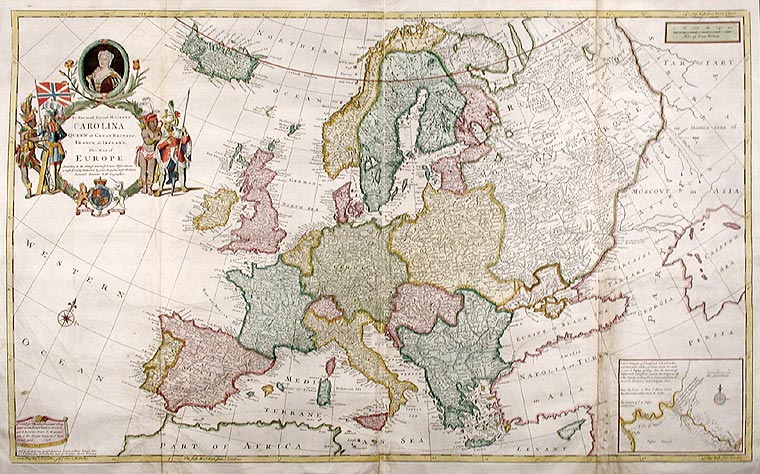
Figure 4-5: Source: https://commons.wikimedia.org/wiki/File:Herman_Moll_Map_of_Europe.jpg Permission: Public Domain.
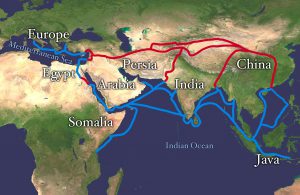
Figure 4-6:
Source: https://commons.wikimedia.org/wiki/File:Silk_route.jpg#/media/File:Silk_route.jpg Permission: Public Domain.
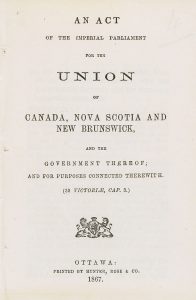
Figure 4-7:
Source: https://commons.wikimedia.org/wiki/File:British_North_America_Act,_1867.jpg Permission: Public Domain.
The dominant narrative of globalization has traditionally painted a rather rosy picture. For the wealthy and those in wealthy countries, globalization represents a spread of liberal, capitalist, and democratic systems and values. It began with the spread of the Eurocentric Westphalian state which has become so hegemonic that its privileged position in global politics is unquestioned. Some may question the injustices that arguably occur because of the nation-state, but few question its privileged structural position.
As the European nation-states began to internalize liberal norms of individual rights and institutionalize democratic processes, these too were diffused through the Westphalian order albeit less equally and slower. For example, while Canada gained domestic sovereignty from the UK in 1867 and Australia gained its independence in 1901, Brunei didn’t achieve independence from the UK until 1984.
This positive narrative is one of innovation in industrialization, transportation, and communication technologies. It is a narrative of moving from sailing ships, to steamships, to container ships, to spaceships. It is a narrative of moving from the ancient Chinese trade routes of the Silk Road to the global supply chains of Multinational Corporations.
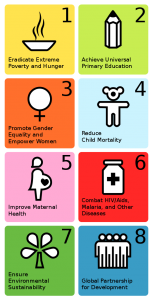
Figure 4-8:
Source: https://commons.wikimedia.org/wiki/File:MDGs.svg#/media/File:MDGs.svg Permission: CC BY-SA 4.0 Courtesy of Kjerish.
It is a narrative of moving from a conflictual world constituted by warring and sovereign states, towards a more peaceful world constituted by shared values and norms around universal human rights. It is a narrative of growth, opportunity, peace, and progress. To support this narrative, advocates of globalization point to the benefits of trade, the growth of global governance, and the growing trend of inter-cultural exchange. In terms of trade, globalization has increased the number and type of goods available everywhere to everyone and at lower prices. This by itself has the ability to reduce poverty rates by providing the poor, whether in the global south or the global north, the opportunity to raise their standard of living. However, advocates also argue the system itself acts to reduce poverty through global supply chains and Foreign Direct Investment.

Figure 4-9:
Source: https://commons.wikimedia.org/wiki/File:Emblem_of_the_United_Nations.svg#/media/File:Emblem_of_the_United_Nations.svg Permission: Public Domain. Courtesy of Spiff-enwiki.
Today, it is very likely that what we wear, what we eat, what we drive, what entertains us, and on what devices, is part of the global supply chain. These products are derived from resources mined around the world. They have been manufactured in multiple countries and may be based on designs made in even more countries. It is very likely that it was marketed and sold in multiple countries in multiple ways. All of this was done to increase market share, reduce costs, and maximize profits. It is the invisible hand of Adam Smith at work: in maximizing our own self-interest, we are maximizing societal benefits globally. This has provided investment in the global south, greater employment opportunities for marginalized people and at greater wages than domestic firms are able to pay. There is some data to support this argument. For example, the percentage of people living under extreme poverty, as measured by living under a 1.90$ a day, has been halved between 1990 and 2015 through programs like the Millennium Development Goal
Beyond trade, advocates of globalization point to increased global governance as a process of pacification. Most formally, there is the rise of intergovernmental organizations: from the Hague Conventions of the 19th century to the International Criminal Court and the United Nations system which include but are not limited to: the Security Council, the General Assembly, the Secretary-General, the UN Development Program, the UN Committee on Trade and Development, the World Food Program, the UN High Commissioner for Refugees, the International Labour Organization, the World Health Organization, as well as the more loosely associated International Monetary Fund, World Bank, and World Trade Organization. Proponents of globalization argue that these institutions have created a rule-based international order that seeks to constrain the hubris of the strong while ameliorating the suffering of the weak. This order is supplemented by the rise of international civil society. These are organizations like Amnesty International, Oxfam, and Doctors Without Borders. They seek to highlight the human dimension of globalization and put pressure on national and international bodies to respect human rights.
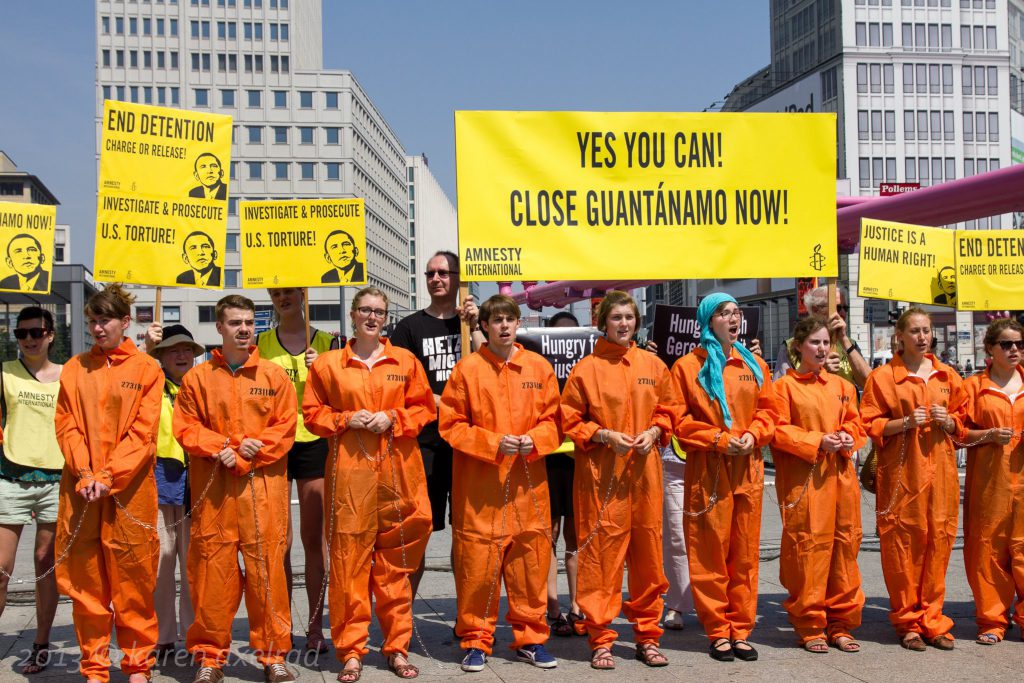
Figure 4-10: https://flic.kr/p/eQGz4c Permission: CC BY-ND 2.0 Courtesy of Karen Axelrad.

Figure 4-11:
Source: https://flic.kr/p/KiLrC7 Permission: CC BY 2.0 Courtesy of Free Images.
Finally, those who support globalization point to the growing trend of inter-cultural exchange. While admitting to the dominance of the West in exporting its cultural goods, other cultural centers have begun to follow suit. Hollywood and European Cinema have been followed by Bollywood, Japanimation, and Hollywood North here in Canada. The American and European music scene has been followed by J-Pop, K-Pop, and other world music trends. Sushi, Curry, Chilaquiles, Kung Pao Chicken, and Pad Thai can be found in almost every country.
Yoga is practiced daily in the West by thousands of people. Shaolin Kungfu can be studied in London, New York, and Saskatoon. These trends have been amplified by increased immigration flows and the prevalence of expatriates, driven by cheap and accessible transportation. Advocates of globalization point to such cultural exchange as evidence of shared identities that transcend and perhaps even supplant national narratives. In sum, this positive narrative of globalization argues that sovereignty is diminishing in the face of economic, political, and cultural processes. Sovereignty is diminished by the increased permeability of borders these processes have wrought. Sovereignty is diminished by the shift to a supranational locus of authority. Sovereignty is diminished by transnational identities. It does not mean that sovereignty is gone or irrelevant but that it is transforming under pressure from the market and civil society. The processes of globalization have transformed our economics, our politics, and our societies.
- Watch Crash Course World History video Globalization I – The Upside #41
- Use the following questions to guide an entry in your Journal
- Why has the scale of economic globalization grown exponentially?
- How does the t-shirt/computer examples represent the contemporary global trade?
- Why have emerging countries been reluctant to liberalise their economies?
- If this is true, why have they done so anyway?
- What are the benefits of global capitalism?
- Why has migration become easier?
- Why has migration increased even if the economy is increasingly globalized?
- What is cultural blending? Examples?
- How does the video come full circle by arguing the t-shirt demonstrates the opportunity presented by globalization?
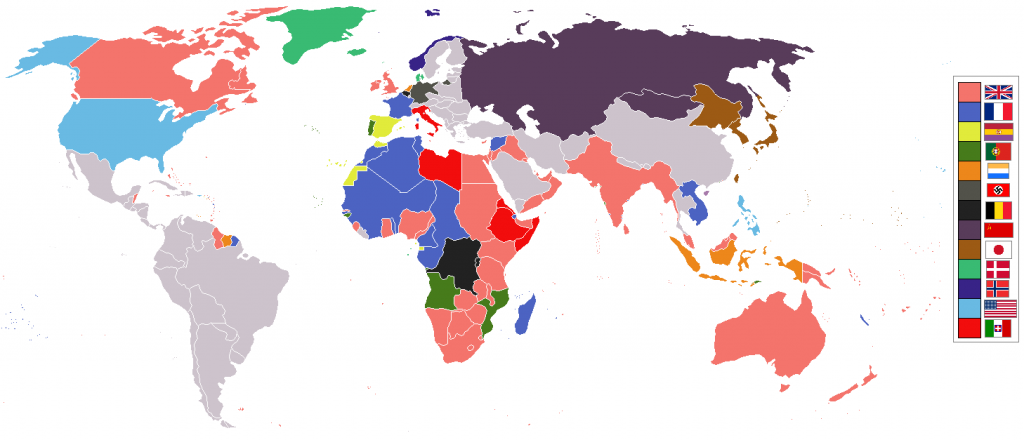
Figure 4-12: World 1936 empires colonies territory. Source: https://commons.wikimedia.org/wiki/File:World_1936_empires_colonies_territory.png#/media/File:World_1936_empires_colonies_territory.png Permission: CC BY-SA 3.0
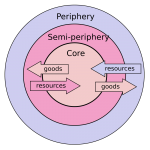
Figure 4-13:
Source: https://upload.wikimedia.org/wikipedia/commons/d/d5/Dependency_theory.svg Permission: Public Domain. Courtesy of Wykis.

Figure 4-14: Colonial Governor of the Seychelles inspecting police guard of honour in 1972. Source: https://commons.wikimedia.org/wiki/File:Seychelles_Governor_inspection_1972.jpg#/media/File:Seychelles_Governor_inspection_1972.jpg Permission: Public Domain.
The dominant and largely positive narrative of globalization has encountered increasing opposition from a variety of sources. These sources do not, for the most part, dispute the basic facts of globalization put forward by its advocates. Rather, they dispute the benefits touted by the pro-globalization camp. Yes, the contemporary processes and manifestation of globalization can be traced to the exportation of the Westphalian nation state. However, it was not with the intent of spreading liberal, capitalist, and democratic systems and values. It was a violent and oppressive process of imperialism and colonialism.
These European colonial powers were seeking access to cheap resources, cheap labour, and new markets to sell their goods. In order to accomplish these goals, they either established direct political control of colonial possessions or used proxies to rule on their behalf. In either case, the means of colonization was the actual or threatened use of military force and maintained with the actual or threatened use of violence. The colonial economies were restructured to the benefit of the metropole, sending cheap resources back, sometimes including human slaves, and accepting the manufactured output of their colonizers. The colonial political structures were intentionally weak and dependant on the metropole. If local political actors rejected or obstructed the edicts of the metropole, they would be replaced or possibly killed. The colonial social norms and values were defined by the metropole. These ideational structures put the metropole and its representatives in a privileged light while undermining traditional sources of authority.
In the end, colonialism and imperialism have left behind conditions and institutions in post-colonial states which have proven unstable in many parts of the world. Conversely, colonialism was an important driver of European economic development, providing access to resources, cheap labour, and new markets.

Figure 4-15: Source: https://www.pexels.com/photo/stock-exchange-board-210607/Permission: CC0 1.0 Courtesy of Pixabay.
While this generated significant wealth for the colonizer, it came at a cost to the colonized, both in terms of the wealth extracted and the instability subsequently inherited. This is certainly a far cry from the positive narrative of spreading liberal, capitalist, and democratic values and norms. It is a far cry from the narrative of growth, opportunity, peace, and progress. Rather, the critics argue the roots of contemporary globalization are steeped in conquest, in violence, in the exercise of raw power, and in blood. In a similar fashion, these critics view the evidence put forth by the proponents of globalization in a deeply skeptical light. The proponents argue that international trade has driven global economic growth and, in the process, sharply reduced poverty. Critics don’t disagree that globalization has increased the number and type of goods available everywhere and everyone and at lower prices. But this system comes at a price, especially in the global south where these goods are often sold on the market below the cost of local production, something called dumping. This drives out local producers and makes them dependent on the large MNCs of the global north, establishing and perpetuating neo-colonial trade relations. Conversely, when MNCs shift labour to the global south, improving the opportunities for marginalised workers, it is often at the expense of higher paid, often unionized, labour in the north. Thus, while it can be argued that the global supply chain unarguably increases prosperity, that prosperity accrues disproportionately to the 1%; the executives and board members of the MNCs that shift the location of resource extraction, the place of manufacturing, and even where the company is headquartered to maximize their profits.

Figure 4-16:
Source: https://flic.kr/p/azJupf Permission: CC BY-ND 2.0 Courtesy of Joe Wolf.
Even the argument that globalization has reduced by 50% the number of people living under extreme poverty (or 1.90$/day) is problematic. Many argue a more meaningful threshold would be 3$ per day but that would put half the world back into poverty. Moreover, while extreme poverty has been reduced, globalization has also sharply increased inequality both between states and within states. Globally, 70% of the world holds only 3% of the wealth while eight men hold half the world’s wealth. The ten richest billionaires hold more wealth than the state of Norway or the United Arab Emirates. The problem with inequality is that it becomes an obstacle to further growth. Just as an individual who is not in extreme poverty but still poor will have trouble saving money for retirement or for future mishaps, states whose GDP are above extreme poverty lines but still poor will be unable to invest in infrastructure, capital expenditures, and human capital. In both cases, they will hobble along but will be restricted from reaching their full potential.
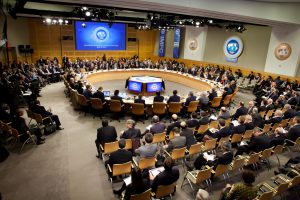
Figure 4-17: IMFC Governors meet at their IMFC Plenary session chaired by IMFC Chairman Tharman Shanmugaratnam April 16, 2011 at IMF Headquarters 2 in Washington, DC. The IMF/World Bank Meetings are being held in Washington, DC this week which will host Finance Ministers and Bank Governors from 187 countries. Source: https://flic.kr/p/9z3CEE Permission: CC BY-NC-ND 2.0 Courtesy of Stephen Jaffe.
Critics also have a starkly different view of those intergovernmental organizations, like the ICC or the UN system, that are supposedly creating a rule based international order constituted by equal sovereign states. Critics argue, that in reality, the UN Security Council is defined by the power politics of the five veto Members. This creates a two tier system in international politics, where these five privileged powers and their proxies can do what they want while everyone else must submit to the rules or face penalties ranging from sanctions to military occupation. Voting within the IMF and the World Bank are defined by quota subscriptions that reflect the relative size of a state’s economy. This ensures that western developed economies hold the majority of the votes, 57% to be exact. The US holds 17% of the vote by itself while the poorest 165 states in the world have only 29% of the vote. One tangible result of weighted voting is that the head of the World Bank has always been an American and the head of the IMF has always been a European. Thus, rather than an international order of equality, peace and prosperity, these international organizations are creating a hierarchical global order where the rich and powerful states create rules that serve their own narrow interests.
In a similar fashion, critics of globalization cast a wary eye on the rise of civil society for two reasons. First, NGOs and other civil society actors suffer from a serious democratic deficiency. These international civil society actors claim to address the problem of global inequality by introducing the will of the people. They claim to represent the downtrodden and marginalized against the greedy MNCs and self-interested states. But who has given them this right? And what global civil society actor gets to claim representation for whom? Further, how democratic are these NGO organizations themselves? How are decisions made in Oxfam or Amnesty International? Who sets the agenda and in whose interests? These are deeply problematic questions that critics of globalization demand answers to. Second, critics of globalization suggest global civil society at best offers a band-aid solution to systemic problems. These actors may attempt to address the worst excesses of global capitalism and political inequality but can they meaningfully solve problems of poverty, inequity, democratic representation, and human rights violations? Oxfam International may claim to seek “lasting solutions to poverty, hunger, and social injustice”. However, Oxfam has been operating since 1942, and we are not much closer to achieving these goals. For the critics of globalization, these international civil society actors at best take the rough edge off of the inequality that is an inherent part of the global order. At worst these actors are complicit in the very inequality they claim to seek to ameliorate.
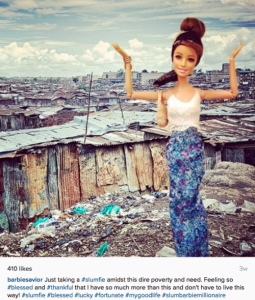
Figure 4-18: Source: https://achurchforstarvingartists.blog/2017/04/30/white-savior-barbie/ Permission: CC BY-NC-SA 3.0
Finally, critics argue that what proponents of globalization call inter-cultural exchange is more likely to be cultural appropriation or Orientalism. For example, yoga or Shao Lin Kungfu may be practiced around the world. But are the majority of the Lululemon wearing suburbanites practicing hot yoga aware of the spiritual significance of the practice? Or is this more of an example of cultural appropriation? The commodification of a religious practice by the rich and wealthy in order to get richer and wealthier? Is the middle school student, with dreams of exotic temples from bad Kung Fu movies, seeking the knowledge of Chan Buddhism? Or is this essentializing what it means to practice Shao Lin down to an image of red temples and flowing saffron robes? Even the cultural mixing brought by the movement of people around the globe is questioned by these critiques. Rather than fostering transnational identities, they argue expatriates and migration flows balkanize societies, drain the global south of much needed resources and has given rise to populist pushback in the north. [carousel source=”media: 352,353″ width=”341″ height=”228″ responsive=”no” items=”1″ title=”no” arrows=”no” mousewheel=”no”] Figure 19 a) Source: https://pixabay.com/en/people-woman-stretching-yoga-2568410/ Permission: CC BY-NC-SA 3.0 b) https://commons.wikimedia.org/wiki/File:Shi_DeRu_and_Shi_DeYang.jpg#/media/File:Shi_DeRu_and_Shi_DeYang.jpg Permission: CC0 1.0 Public Domain. Courtesy of StockSnap. In sum, the negative narrative of globalization would agree that sovereignty is diminishing in the face of economic, political, and cultural processes. But they argue that at best these are well intentioned processes with little hope of mitigating the dark side of globalization. At worst, they are rationalizations and camouflage for those who benefit from the processes of globalization.

- Watch the video by Crash Course World History: Globalization II – Good or Bad? #42
- Use the following questions to guide an entry in your Journal:
- How has globalization impacted what people do for employment in the developed world?
- How has this changed the psychology of people in the west?
- What is individualism? Why does it matter?
- How has globalization impacted population?
- How has globalization impacted the environment?
- How has globalization impacted wealth?
- How has globalization impacted health?
- How are population, wealth, health, and the environment connected?
- How does the analogy of the flower represent the problems of globalization?
- Do the benefits of globalization outweigh the costs?
- Given the trajectory of contemporary globalization, how will the future judge the present?
- How has globalization impacted what people do for employment in the developed world?
Figure 4-20: Source: https://flic.kr/p/9qUAKx Permission: CC BY-NC 2.0 Courtesy of depict.info.
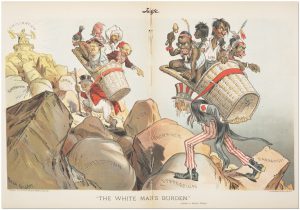
Figure 4-21: This cartoon depicts a representation of Rudyard Kipling’s famous poem The White Man’s Burden. Originally published in February, 1899 the poem’s philosophy quickly developed as the United States response to annexation of the Philippines. The United States used the “white man’s burden” as an argument for imperial control of the Philippines and Cuba on the basis of moral necessity. It was now the United States’ moral duty to develop and modernize the conquest lands in order to help carry the foreign barbarians to civilization. Source: https://commons.wikimedia.org/wiki/File:%22The_White_Man%27s_Burden%22_Judge_1899.png#/media/File:%22The_White_Man%27s_Burden%22_Judge_1899.png Permission: Public Domain. Courtesy of Victor Gilliam.
Debates around the concept of global citizenship as seen through the lens of globalization center around two questions. First, is globalization a given reality? Or can the globalization genie be put back into the bottle? As we have seen above, there is a debate as to whether the processes of globalization are a net benefit or a net cost. However, this debate doesn’t question whether the contemporary processes of globalization are a given. They both accept the processes of globalization as a tangible reality. As we have seen in previous modules, some disagree with this assertion. Communitarians argue that borders need to be strengthened or reinstated. They argue meaningful political authority cannot exist above the state and that nations are the largest form of community practically possible. Further, they contend that it is community that gives meaning to our lives. Justice is therefore defined by the right of self-determination, the right of communities to forge their own definition of the good life. From this communitarian perspective, the goal should be to fight globalization, not whether it is good or bad. From this perspective, the pursuit of global citizenship is at best misguided and naïve. At worst, it is either dangerous or unjust. However, if globalization is an uncontested reality, the second question comes into play: can global citizenship be a force for good in the processes of globalization? On one side, global citizenship has the potential to cement the positive aspects and reduce the negative aspects of globalization. Economically, global citizenship may provide the means to address endemic global poverty and combat rising inequality. If we individually and collectively have rights and obligations that extend beyond our borders, it means that things like global poverty, global inequality, the global environment, and human security are issues to be addressed. They must be addressed not simply as an issue of global peace and prosperity, but ethically and morally as a question of right and wrong. In order to achieve meaningful gains on these global issues, international political structures need greater transparency, greater equality, and greater representation of civil society. Those who self-identify as global citizens have at times, although not always, been the vanguard of such a movement. They have created, volunteered with, and given voice to NGOs and social movements that seek to provide such representation for the marginalized and to seek meaningful change. Culturally, these self-identified global citizens have played a more contested role. Some have certainly sought to truly engage in a respectful way with global cultures, learning the meaning behind objects, traditions, and practices. But many others have ignorantly treated such things as exotic or as something to be consumed as entertainment. In sum, global citizenship, as under defined as that term may be, does potentially contribute to advancing the positive narrative of globalization and to mitigating the negative aspects. These global citizens have the potential to be advocates for the marginalized, the dispossessed, and those who may be left behind through global transformations.
However, there is the other side to the argument. For many, global citizens are representatives of the 1%, of the global elite. Despite their role in NGOs or other social movements which rhetorically seek to ameliorate the worst excesses of globalization, these are often the people who have directly or indirectly benefited from these global economic, political, and cultural processes. Economically, the vast majority of global citizens are from a privileged background. In fact, it is their privilege that allows them to be advocates. Further, many global citizens do not contest the particular forms of economic and political globalization that are causing harm. Rather, they seek to emulate the processes that have worked in the west and apply them in the global south. But they often do so without taking into account that perhaps the success of globalization in the west was dependent on inequality, was dependent on extracting wealth from the colonies for the betterment of the metropoles. The question that needs to be addressed here is whether it is possible to emulate the past or if we need to rethink the form and function of the processes driving globalization. Further, that if the form of globalization itself needs to be redesigned, are those who identify as global citizens the best ones to be leading such change? This critique of global economic processes and of the role of global citizenship is connected to the critique of global political processes. Critics of globalization argue that the material benefits that accrue from economic globalization are supported by the political structures. Moreover, that the political institutions that govern international relations are constituted by many of these self-identified global citizens. Again, these are individuals who may very well have good intentions but they are working within a structure that privileges certain actors, certain processes, certain rights and obligations. The processes and structures of globalization are not neutral. They are not inevitable. They have been consciously created to the benefit of some and to the detriment of others. Self-identified global citizens have played a very large part in the creation and maintenance of this system.
Finally, critics of globalization point to the numerous examples of supposed global citizens treating other cultures as something to be experienced and something to be consumed, rather than something that should be respected and learned from. Take for example the voluntourists taking selfies with poor children while spending two weeks building a schoolhouse in the global south. Or even more malevolently, when Oxfam relief workers took advantage of the destitution wrought by the 2010 earthquake in Haiti by paying for sex. Both examples highlight the tension between people who identify to some degree as global citizens but use their privileged position for their own interests. In so doing, the further entrench the image of global citizens as saviours, coming to the rescue of the poor and the downtrodden. They further entrench a value system that puts western society and culture at the top of the pyramid with others being less civilized, less meaningful… simply less.
- Watch the two satirical videos by SAIH Norway
- ‘Let’s Save Africa – Gone wrong’
- ‘Who Wants To Be A Volunteer?’
- Use the following questions to guide an entry in your Journal
- How do these two videos portray:
- The development field?
- People who volunteer to ‘save Africa’?
- Is there an implied hierarchy of culture in these videos?
- How are these videos relevant to the discussion of global citizenship?
- How do these two videos portray: