NGC 2910
NGC 2910 is a young open cluster located in the Vela constellation in the southern sky. It was first discovered in 1834 by British astronomer John Herschel, and is considered an I2p cluster in the Trumpler open cluster classification system. This means the stars are strongly concentrated, they have an average range in brightness between them, and that there are a relatively poor number of stars (<50).
Prior scientific research conducted on NGC 2910 has found varying results from photometry and others methodologies in terms of determining the characteristics of the cluster. According to Giorgi et. al (2018), it has only been truly studied by 4 prior teams, and each endeavor found significantly different estimates of cluster star count, age, distance, and reddening. For example, Topakktas (1981) estimated a figure of 34 star members of the cluster, while the Giorgi et. al found only 6 probable members. The 2018 study determined NGC 2910 is a member of the Vel OB1 association and the Local Arm in the third galactic quadrant based on its calculated distance.
In order to study NGC 2910 and investigate the relationships between the colour, brightness, and the age and chemical composition of the cluster as a whole, I collected 15 images of the cluster using the PROMPT-MO-1 telescope in Australia which is available on Skynet. I used a B-filter in a 45 second exposure, V-filter in a 30 second exposure, and R-filter in a 20 second exposure, and repeated taking these three images of the cluster 5 times with at least an hour between each set. I then used Afterglow to layer and stack my images to produce a single coloured (unadjusted) image.
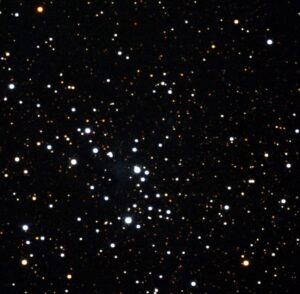
Figure 1: Apparent colour image of NGC 2910
Next, I used Cluster Astromancer to estimate the cluster’s proper motion and distance using the Field Star Removal tool, and I integrated Gaia and 2MASS archive data into my own. Then, using the Isochrone Matching tool, I estimated some of NGC 2910’s astrometric parameters (distance, age, metallicity, and reddening) by finding a best fit line for my data in an HR diagram, a V vs B-V plot, an R vs B-R plot, and an H vs J-H plot.
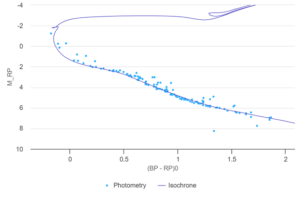
Figure 2: HR diagram for NGC 2910
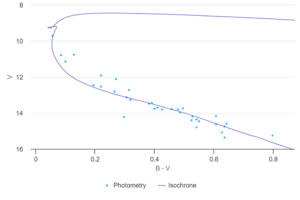
Figure 3: V vs B-V plot for NGC 2910
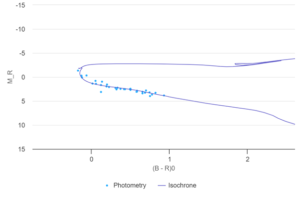
Figure 4: R vs B-R plot for NGC 2910
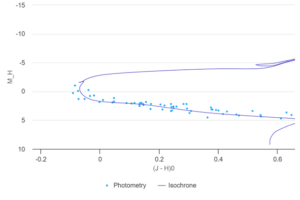
Figure 5: H vs J-H plot for NGC 2910
The following data was found from the analysis:
Table 1: Estimated parameters of NGC 2910
| Proper Motion RA
(mas/yr) |
Proper Motion Dec
(mas/yr) |
Distance
(kpc) |
Log Age
(yrs) |
Age
(Myrs) |
Metallicity
(solar) |
Reddening/E(B-V)
(mag) |
| -6.77 | 6.13 | 1.28 | 8.15 | 141.25 | 0.2 | 0.18 |
Finally, based on the parameters determined through the analysis of the diagrams and fitting the Isochrone to the data, I used the reddening value that was estimated to produce a final adjusted image of the NGC 2910 open cluster.
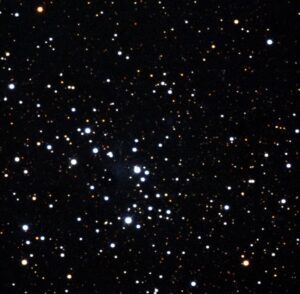
Figure 6: De-reddened combined image of NGC 2910
Because NGC 2910 is an I2p cluster with relatively few stars that are also quite concentrated, it was difficult to analyze. There was less data to use to fit the Isochrone models than in other cases. The distribution does not show any clear “stragglers” or other significant variation from the fitted line.
Comparison of my results with data produced by Karchenko et. al (2013) highlighted significant differences. Below is the data from the previous study.
Table 2: Parameters for NGC 2910 from Karchenko et. al (2013)
| Distance
(kpc) |
Log Age
(yrs) |
Metallicity
(solar) |
Reddening/E(B-V)
(mag) |
| 1.88 | 7.2 | N/A (used 0 for calculations) | 0.396 |
I produced two diagrams demonstrating the fit of these alternate parameters to the data.
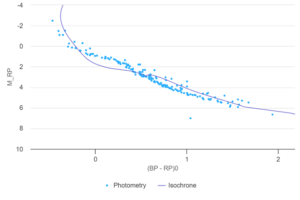
Figure 7: HR diagram for NGC 2910 based on Karchenko et. al (2013) parameters
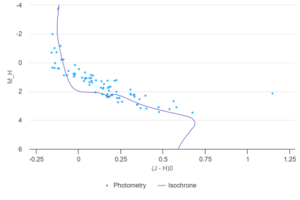
Figure 8: H vs J-H plot for NGC 2910 based on Karchenko et. al (2013) parameters
In analyzing the resulting diagrams, I concluded my astrometric parameters determined from photometry and Isochrone fitting did improve on existing research for NGC 2910. The diagrams created from my found parameters were clearly a better fit. This aligns with the 2018 Giorgi et. al research which states there is significant variation in parameter estimates for NGC 2910 between studies in the last 50 years.
Having completed my analysis, my greatest takeaway was how many different factors must be considered when attempting to produce an accurate image of a star cluster. Because of interstellar reddening, images need to be adjusted to be accurate; where the actual adjustment figure comes from relies on many factors that are estimated based on our knowledge of the aging of stars. It is not a simple exercise to produce a remotely accurate image of a space object. I also learned from this project that although astronomers know so much about space and the world beyond Earth, there is still so much to be discovered, mapped, and calculated. Not every star is fully understood and well documented.
I greatly enjoyed the procedure of this research project and feel I am proud of what I learned and have produced.