Globular clusters are fascinating objects that have captured the attention of astronomers of all skills and backgrounds for centuries. There are over 150 known globular clusters in the Milky way. These clusters are made of thousands to millions of stars that are gravitationally bound together. One of these worth exploring is NGC4833. This old globular cluster ( around 10 billion years!) was discovered by Abbe Lacaille in 1751 and was officially catalogued in 1955; by James Dunlop and Sir John Herchel. It is located in the southern constellation known as Musca (wiki) .
NGC4833 is featured in many published papers studying the age , stellar populations, and other properties of globular clusters. One such publications outlines some of the main attributes of this cluster. Outlining that the horizontal branch of this cluster is “predominately blueward of the instability strip with 13 Lyraes measured”, Jasoune Melbourne, Ata Sarajedini, Andrew Layden , Donal H . Martins (2000).
To study this cluster for myself, I utilized a robotic telescope made available by the Astronomy program at my University. I was able to take control of the Skynet Prompt5 telescope located in Cerra Tololo. It is a robotic CCD telescope that is operational via remote communications through the internet.

My goal was to observe the true colours of the cluster as well as the brightnesses of the stars and the overall age and chemical composition of the cluster. To do this I took 15 separate images spanning evenly over three filters. I used Skynet Afterglow to then stack the images based on filters ( B , V , and R) and then blended together to make a full colour image. Once this process was complete I used the data collected from Skynet and plotted it using Cluster Pro Plus to take a closer look and observe relationships between key data structures.

With the use of such tools I was able to draw my own conclusions of NGC4833 and its properties; then compare them to the pre logged MWSC (Milky Way Star Cluster) catalogue. I was also able to observe any remarkable features in my graphs.

The model I generated with my own estimated parameters appears to be slightly more fitting than the MWSC. The isochrone model of MWSC follows the main sequence nicely , but the trend goes off the path of the red giant branch; also the moderate population of blue starts is missed. The two parameters that differed most in my analysis where distance and Metallicity, so I could argue that there are possible errors with the MWSC values of these two parameters, specifically the distance; since the difference is quite large.
By investigating this cluster and observing its graphs I was able to identify a healthy balance of star types and colours. A densely populated main sequence, a turn off point of increasingly large and more red stars, a small population of red Giants, and a mostly blue horizontal branch. I was also able to find a more accurate E(B-V) value of 0.33 mag and produce a finished and de-reddened version of my original image.
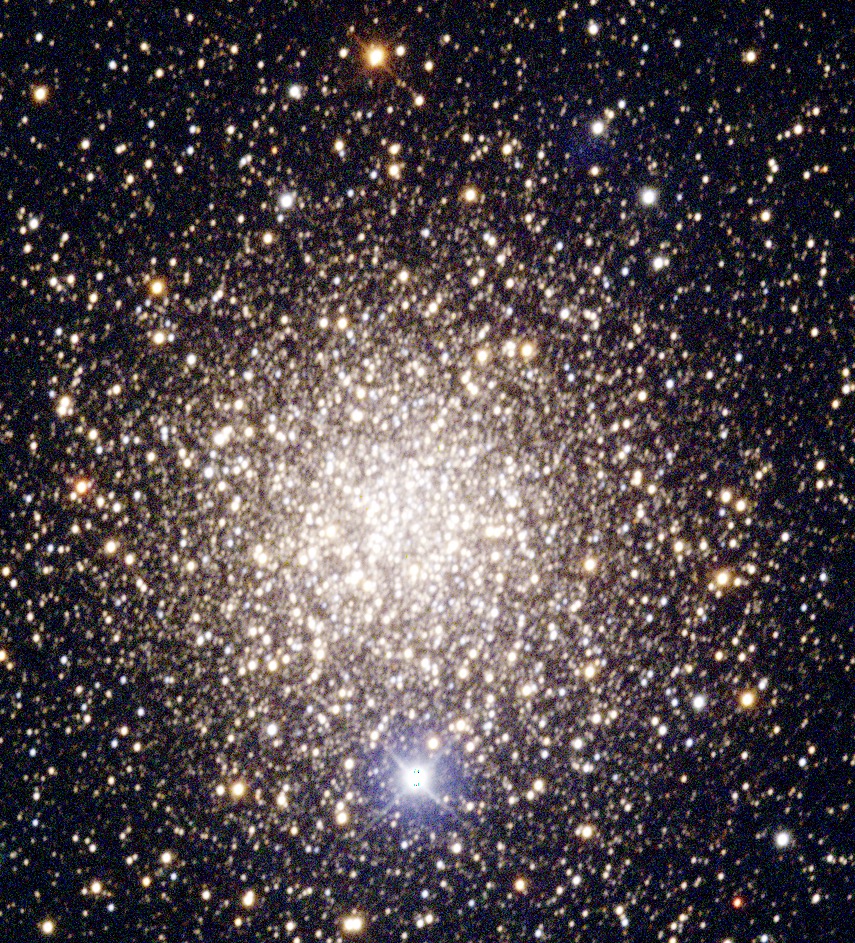
my finished image
I started out this project motivated by the opportunity to utilize the amazing tools and instruments made available to me as a participant in Astronomy studies in my university. I chose an old globular cluster because I knew they were known to be visually stunning. Once my colour images were created I was not disappointing as this cluster is breathtaking. But quickly the analysis of the data became the most exciting venture. Overall I think I was able to end with a very well fitting Isochrone model of NGC 4833 and a better overall understanding of the nature of clusters .