
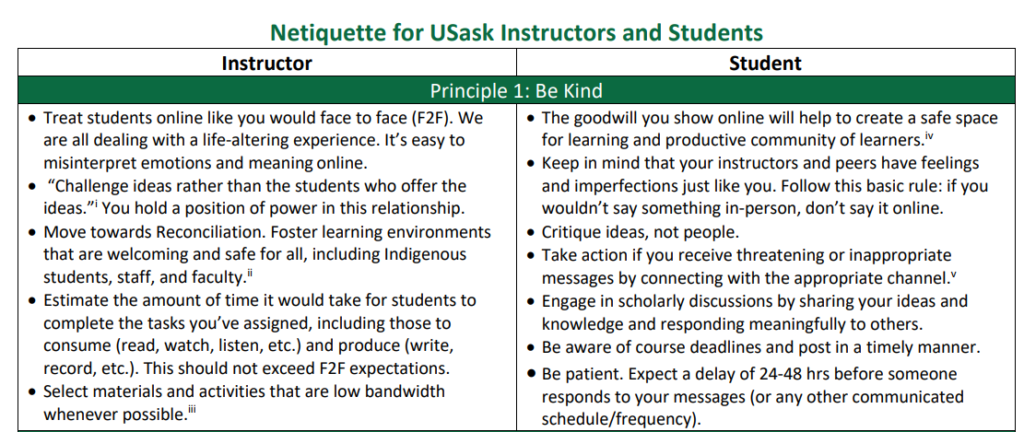
✔️ Interactions and discussions are conducted in an inclusive and culturally sensitive manner. Guidelines for respectful communication or “netiquette” are provided.
Review These Explanations

Photo by Glenn Carstens-Peters on Unsplash
In online learning environments, the importance of conducting interactions and discussions in an inclusive and culturally sensitive manner cannot be overstated. The virtual classroom often brings together students from diverse cultural backgrounds, and promoting cultural sensitivity ensures that every student feels valued and respected.
Establishing guidelines for respectful communication, or “netiquette,” is essential to avoid misunderstandings and promote constructive dialogue. Inclusivity in discussions creates a safe space where students can freely express their thoughts, fostering a positive and collaborative learning environment. Furthermore, culturally sensitive interactions contribute to the development of cultural competence, preparing students for effective communication in diverse professional settings. Netiquette guidelines play a crucial role in setting expectations for polite and respectful online communication, enhancing the overall learning experience and building positive interpersonal connections among students. Prioritizing cultural sensitivity in online interactions not only aligns with equity and inclusion policies but also contributes to a harmonious and enriching educational community.
Is a hybrid of “internet” and “etiquette,” refers to the set of guidelines and rules governing good and considerate behavior in online communication and interaction. It encompasses the social norms and practices that individuals should adhere to when engaging in various online platforms, forums, emails, or any other digital communication channels.
Refresh Your Course with These Ideas
General Suggestions:
- Clearly communicate expectations for inclusive and respectful interactions.
- Encourage the use of inclusive language in discussions.
- Ensure learning materials represent diverse cultures and perspectives.
- Emphasize the importance of active listening in discussions.
- Incorporate collaborative activities to promote peer learning.
- Clearly outline netiquette guidelines for respectful communication.
- Train instructors or assistants to moderate discussions effectively.
- Foster an environment encouraging open dialogue about cultural differences.
- Use examples and scenarios reflecting diverse cultural contexts.
- Establish a feedback mechanism for students to provide input on inclusivity.
- Model inclusive behavior by valuing diverse opinions and addressing insensitivity.
- Integrate assessments measuring cultural competency for reflection.
- Provide opportunities for students to reflect on their cultural biases.
- Collaborate with diversity and inclusion offices for additional support.
- Provide cultural competence training for instructors.
- Soler-Costa R, Lafarga-Ostáriz P, Mauri-Medrano M, Moreno-Guerrero AJ. Netiquette: Ethic, Education, and Behavior on Internet-A Systematic Literature Review. Int J Environ Res Public Health. 2021 Jan 29;18(3):1212. doi: 10.3390/ijerph18031212. PMID: 33572925; PMCID: PMC7908275.
- Heitmayer, M., & Schimmelpfennig, R. (2023). Netiquette as digital social norms. International Journal of Human–Computer Interaction, 1–21. https://doi.org/10.1080/10447318.2023.2188534
- What is Netiquette? 20 Internet Etiquette Rules
- Discussing
- Open University