
✔️ Learning materials are offered in multiple formats (e.g.: text, visuals, video, audio, interactive simulations, etc.)
Review These Explanations
Photo by Firmbee.com on Unsplash
Learners possess diverse preferences and styles, and providing content in various formats accommodates these differences. It enhances accessibility for individuals with diverse abilities, promoting inclusivity. Additionally, offering multimedia elements such as videos, interactive simulations, and audio not only caters to different learning styles but also sustains learner engagement. Flexibility is another key advantage, allowing learners to choose the format that best suits their schedule, device, or personal preference. The combination of text, visuals, and auditory elements reinforces learning, improves retention, and simulates real-world applications, making the educational content more relevant. By providing options that cater to various technology access levels ensures accessibility for a broad audience. When your course offers multiple formats it aligns with Universal Design for Learning (UDL) principles, fostering a dynamic, adaptable, and equitable online learning environment.
The origin of Universal Design for Learning can be traced back to architecture, where it was initially conceived to design physical environments that ensure accessibility for everyone (Nelson, 2014). The three core principles include multiple means of representation, allowing information to be presented in various formats to accommodate diverse learning styles; multiple means of engagement, providing diverse and motivating learning experiences tailored to individual preferences; and multiple means of action and expression, allowing students to demonstrate their understanding through various methods. By adhering to UDL principles, educators strive to address the diverse needs, preferences, and abilities of learners, fostering an inclusive educational experience that promotes engagement and success for every student.
Universal Design for Learning One Small Step
Refresh Your Course with These Ideas
General Suggestions:
- Create content in diverse formats: text, video, audio, images and interactivity.
- Integrate multimedia seamlessly into course modules.
- Provide accessibility features: transcripts for videos, alternative text for images.
- Organize content clearly for easy navigation using menus and hyperlinks.
- Conduct a survey to understand learners’ format preferences at the beginning of a course.
- Consider different learning styles when designing content.
- Encourage regular feedback for continuous improvement.
- Provide student training resources on accessing various content formats.
- Use content conversion tools for flexibility.
- Collaborate with multimedia experts for insights and assistance.
- Keep all formats regularly updated for relevance and accuracy.
Example
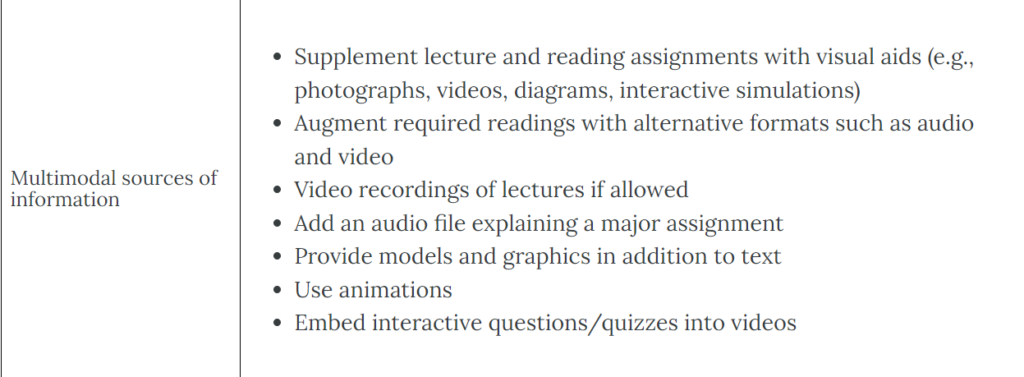
Multimodal Review Activities Example
Auditory Learners:
Auditory learners learn best through listening. Offering recorded lectures, podcasts, or discussions can cater to their needs. Additionally, providing access to verbal instructions or explanations can enhance their comprehension.
Kinesthetic/Tactile Learners:
Kinesthetic learners benefit from hands-on experiences and physical involvement. Interactive materials, simulations, or practical applications can enhance their understanding. Access to labs, simulations, or real-world examples can support their learning style.
Reading/Writing Learners:
Some students prefer written information and may excel in reading and writing. Providing comprehensive written materials, such as textbooks, articles, or detailed notes, can support their learning style. Access to written resources for self-study or research can be valuable.

Visual Learners:
Visual learners grasp information better through images, charts, and graphs. Providing visual aids, infographics, or diagrams alongside written content can be beneficial. Access to slides, mind maps, or visually organized materials can support their learning style.
References:
Nelson, L. L. (2014). Design and deliver: Planning and teaching using universal design for learning. (No Title).