
✔️ Criteria for the assessment of all graded assignments are clearly articulated (rubrics, exemplary work).
Review These Explanations
Rubrics are recommended as a best practice for communicating criteria and achievement levels for assignments in online courses. Elikai & Schuhmann (2010) found that grading policies and associated rubrics motivated learning by associating levels of mastery and performance with a specific grade, and guiding achievement progress.
According to Worlf & Goodwin (2007), rubrics:
- Make learning targets clearer;
- Guide the design and delivery of instruction;
- Normalize the assessment process; and
- Give learners self- and peer-assessment guidelines.
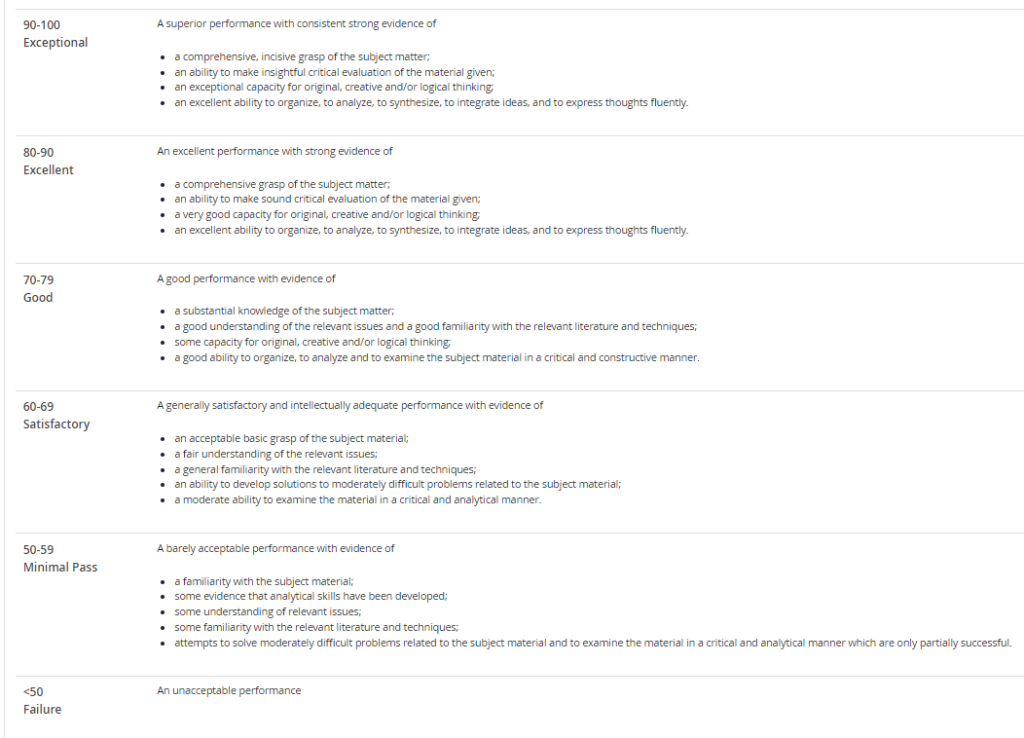
Guidelines or rubrics for the assessment of graded work should include performance criteria, setting desired performance/proficiency levels for learners, and creating performance descriptions. This includes providing details for what constitutes the continuum of accomplishment, from unsatisfactory through to exemplary, and includes grades associated with each level along the continuum. Criteria for grading schemes (points and percentages) and ranges should be clear (what gets and A, B, and so on), and tie directly to the goals and objectives of the assigned work that is to be evaluated.
Showcasing exemplary work provides learners with a clear example of what outcomes the assignment demands, and what mastery levels need to be reached. Before posting exemplary work, be sure to get permission from the learner whose work you would like to showcase.
Refresh Your Course with These Ideas
General Suggestions/Resources
- Create public and private opportunities for interaction with the instructor to ask questions, get help, seek clarification on course assignments, activities, assessments, expectations and grading criteria.
- Use rubrics to provide objective and substantive feedback.
- Provide models and examples of exemplary work to illustrate assignment expectations and rubric criteria.
- Keep a folder of exemplary course work outside of your courses, so that you can access it at any time – even long after a course has ended.
- Use examples of exemplary course work as models in your course, so learners can see an example.
- Designing Authentic Online Assessments
- Assessing Student Learning Online
- Nine Principles of Good Practice for Assessing Student Learning
- Assessing Online Learning
- Tips for Exams and Alternative Assessments
- Alternatives to Traditional Testing
- Online Assessment Techniques (OATs)
- Online Feedback and Assessment (Minilog Video Playlist)
- Fostering and assessing equitable classroom participation
- Five Norms and Five Rubrics for High-Quality Online Learning
- Formative and Summative Assessments
- Peer Assessment
- Self Assessment
Rubrics/Tools:
- Use the rubric features within the LMS.
- Give learners a grading rubric checklist to complete before they turn in any work.
- Review course rubrics from other faculty, or online resources.
- Creating and Using Rubrics for Assessment
- Rubrics
- Using Rubrics
- Authentic Activities, Assessments & Rubrics – ppt.
- Resource Rubric
- Rubistar
- RCampus Rubrics
- Five Norms and Five Rubrics for High-Quality Online Learning
- Synchronous Participation Rubric
- Rubric for Assessing Interactive Qualities of Distance Learning Courses
Examples
University of Saskatchewan Undergraduate Example
Read more:
Explore More Refreshing Ideas from the Teaching Online Pedagogical Repository (TOPR) at the University of Central Florida (UCF)
This Pedagogical Practice from TOPR explores methods and approaches to providing clear rubrics for learners in support of learner success in online courses.
Use Rubrics to Evaluate Students’ Online Discussions
References:
Elikai, F., & Schuhmann, P. W. (2010). An examination of the impact of grading policies on students’ achievement. Issues in Accounting Education, 25 (4), 677-693.
Wolf, K. K., & Goodwin, L. L. (2007). Evaluating and Enhancing Outcomes Assessment Quality in Higher Education Programs. Metropolitan Universities, 18(2), 42-56.